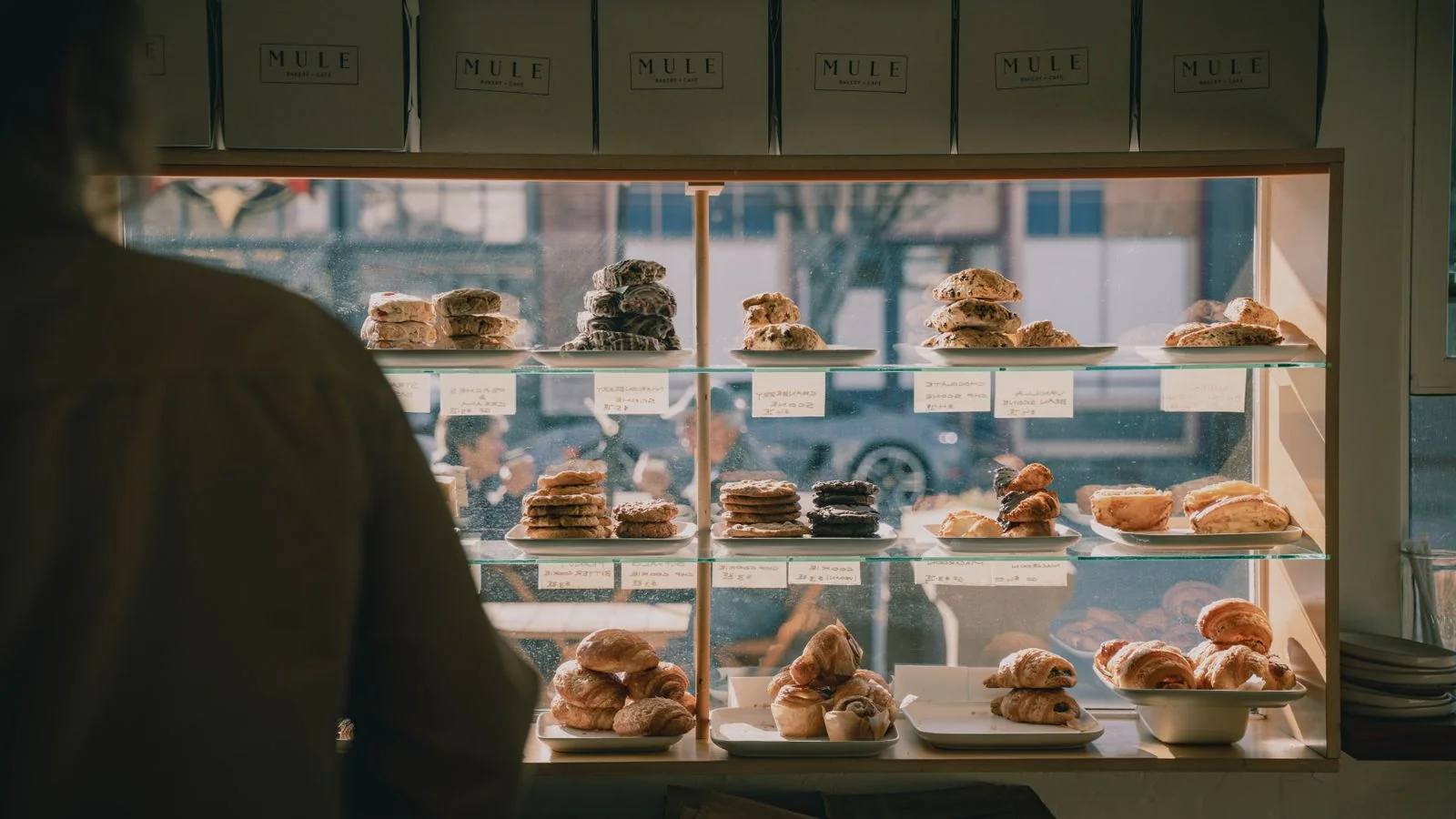
Open Google, type the name of your city and the words “best croissant,” and count how many of the top ten results are bakeries. In most cities the answer is zero or one. The rest are listicles assembled by writers who have never laminated dough, ranking shops they visited once, if at all.
That gap is the whole opportunity. The people with the least knowledge about baking are producing almost all the published knowledge about baking in your market, and they are the ones buyers, journalists and answer engines learn from.
Thought leadership for bakeries and cafes is not a content calendar. It is the decision to stop letting other people narrate a craft you have spent years inside.
Your counter is the worst classroom you own

Every owner I talk to believes the education happens at the counter. A customer asks why the sourdough costs seven dollars, and the baker explains the 36-hour ferment, the local mill, the fact that nobody is getting rich here. The customer nods. The line behind them grows.
Three things go wrong with that classroom. The conversation lasts ninety seconds, it reaches one person, and it disappears the moment it ends. You have delivered an expensive piece of expertise into a room with no recording device.
Meanwhile the same question gets asked forty times a week, and someone in your city has written a blog post answering it badly. That post ranks. It gets quoted in a local roundup. An answer engine reads it, compresses it, and repeats a mangled version of your craft to someone deciding where to spend money on Saturday morning.
The fix is not more explaining. It is explaining once, in a place that keeps the explanation.
The Proof Shelf: four kinds of knowledge you already own
Most bakery owners stall at the same place. They accept the argument, sit down to write, and find they have nothing to say. That is never true. It means nobody has shown them where to look.
I use a simple sort called the Proof Shelf. Four shelves, and everything worth publishing sits on one of them.
The first shelf is cost knowledge. You know what butter did to your margins this year in actual numbers. You know what a bag of flour cost in January and what it costs now. You know that a croissant priced at five dollars loses money at your labor rate and a scone priced at four does not. Almost nobody publishes this, because bakers are trained to treat pricing as embarrassing. It is the most-read thing you can write.
The second shelf is failure knowledge. The batch you threw away. The wholesale account that collapsed because you underestimated delivery. The espresso machine you bought twice. Every trade publication runs success stories, so a specific and unflattering post-mortem stands out in a category where everyone is posing.
The third shelf is process knowledge, the part that looks obvious to you and looks like magic to everyone else. Why the first pastry out of the oven is never the one you sell. What humidity does to a proof schedule in August versus February. Why your cafe grinds to order and what that costs in throughput.
The fourth shelf is judgment knowledge, the calls that have no correct answer. Whether to open a second location or deepen wholesale. Whether to chase the trend item or refuse it. Whether to raise prices or shrink the pastry. Readers who run their own shops will read this shelf twice.
Run your last month through those four shelves and you will surface a year of material. The bottleneck was never subject matter.
Write the thing only someone who bakes at 3am can write

Here is the test that decides whether a piece is worth publishing. Could a competent freelance writer with a search engine have produced it in an hour? If yes, kill it. It will rank against ten thousand identical posts and it will teach a reader nothing.
“Five tips for better sourdough” fails the test. “Why I stopped selling sourdough on Mondays and what it did to my week” passes it, because the only way to write that piece is to have run a bakery on a Monday.
This is also what separates content that answer engines cite from content they ignore. Systems like ChatGPT and Perplexity synthesize from the material available to them, and material available in a thousand near-identical versions carries no weight. A specific claim, attached to a named business, with a number in it, is the kind of thing that gets pulled into an answer and attributed.
Specificity is not a style preference here. It is the mechanism.
So write the 3am pieces. The temperature you actually hold your retarder at and why the textbook number is wrong for your building. The month you tracked waste and what you found. The wholesale contract clause you now refuse to sign. Nobody can copy those, which is precisely why they work.
Wholesale buyers read differently than customers
A retail customer reads to decide where to go this weekend. A wholesale buyer reads to decide whether you will still be operating in eighteen months and whether you will show up at 5am with the right count.
Those are completely different anxieties, and most bakery content only speaks to the first one.
When a cafe group is choosing a pastry supplier, the questions behind the questions are about reliability, capacity, consistency and what happens when something goes wrong. A post about your delivery process, your contingency when a van breaks down, or how you handle a short order reads as tedious to a retail audience and as reassurance to a buyer holding a purchase order.
This is the highest-return content a bakery can publish and the least published. Write one piece a quarter aimed squarely at the person who buys in volume. Describe your capacity honestly, including its ceiling. Explain what you will not take on. Buyers trust a supplier who names their limits far more than one who claims none.
Thought leadership for bakeries and cafes pays out fastest here, because a single wholesale account is worth more than a thousand retail visits and the decision maker is someone who reads before they call.
Where to publish when nobody is reading yet
The objection arrives on schedule. Nobody reads our blog, so why write one.
Correct, and it does not matter, because your blog is not the destination. It is the proof that lets you be published somewhere with an audience.
The sequence works like this. You write four or five real pieces on your own site, which costs nothing but time. Those pieces become the evidence a trade editor needs when you pitch. Bakery and hospitality trade press runs constantly short of practitioners willing to write, because most operators are too busy and the ones with time usually have nothing to say. You now have both a track record and a point of view.
From there the ladder is short. Local business press covers operators with a position on costs, labor or a neighborhood. Trade publications want process and economics. National food media wants a fight, a trend called early, or a number nobody else has.
Every rung feeds the others. The trade piece gets quoted locally. The local piece gets read by a wholesale buyer. And each published piece, under your name and your bakery’s name, becomes another source that answer engines read when someone asks which bakeries in your city are worth knowing about.
None of this requires a marketing budget. It requires being the person in your market who bothered to write things down.
What twelve months of this actually looks like
Set the bar low enough that you will not quit. Two pieces a month, eight hundred words each, written badly and fixed afterward. That is twenty-four pieces a year, which is more than every competitor in your city combined.
Front-load the cost shelf and the failure shelf, because they are the fastest to write and the most likely to travel. Aim one piece per quarter at wholesale buyers. Pitch a trade publication once you have five pieces live, and expect the first two pitches to go nowhere.
By month six you will notice something specific. People arrive already persuaded. A buyer mentions the post about delivery windows. A reporter calls you instead of the shop with a bigger Instagram following. A customer at the counter asks about the flour mill before you bring it up.
That is the shift worth chasing. Not traffic, not followers, but arriving at conversations with the credibility argument already won.
Start this week. Open a document, write down the three things about your costs that would surprise a customer, and publish the one that makes you slightly uncomfortable.