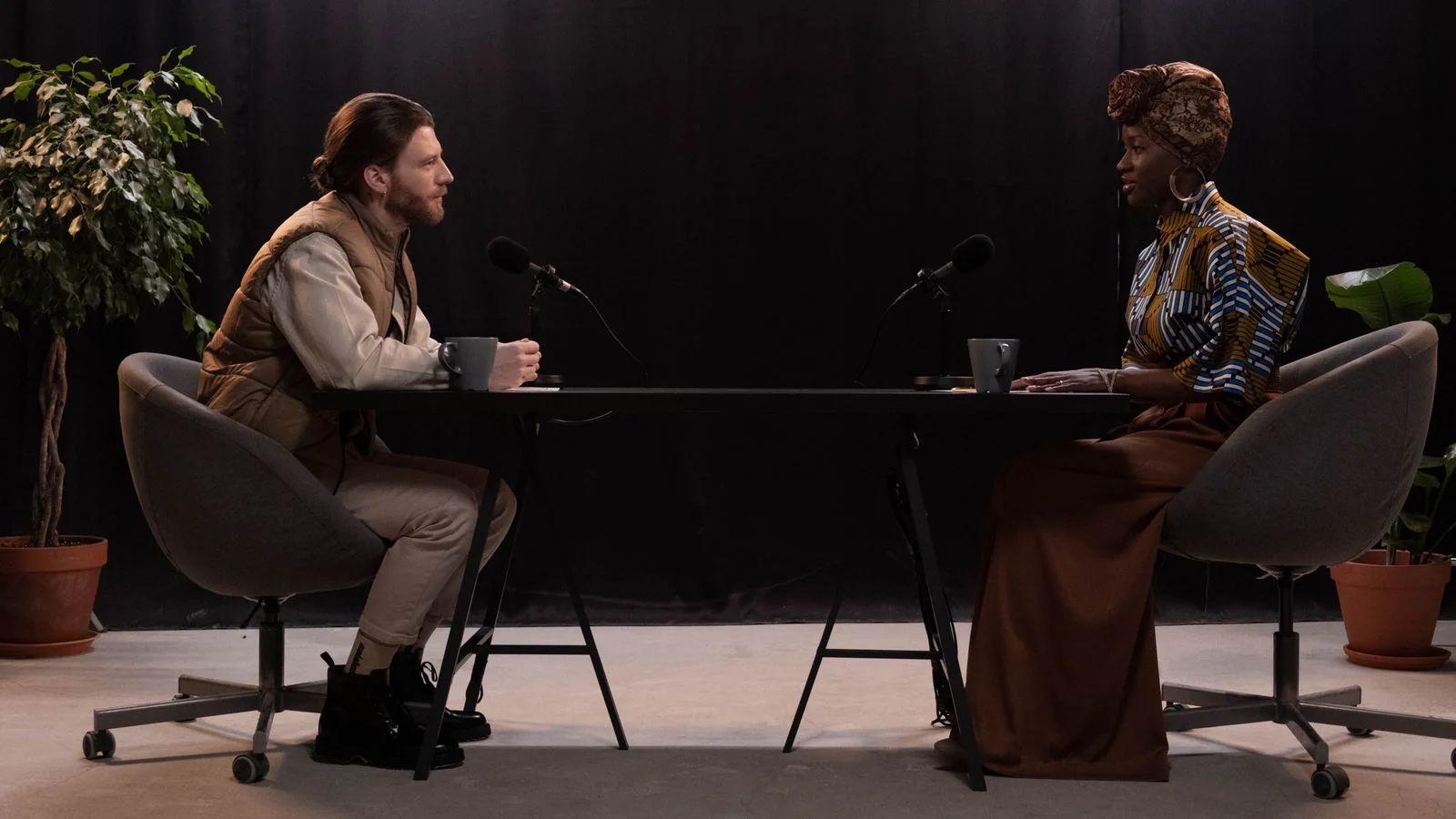
How many episodes have you recorded, and could a regular listener state your view on the central question in your field?
For most hosts the honest answer to the second part is no, and the number in the first part makes it worse. Two hundred conversations with smart people and no discernible position of your own is not neutrality. It is an absence that the audience notices, even when they cannot name it.
Thought leadership for podcasters starts at the point where you stop being the person who asks and become the person who claims. That transition is uncomfortable, it costs you something, and it is the only thing that converts a show into authority.
Why does interviewing not make you an authority?
Because curation and judgment are different skills, and audiences distinguish between them without being told.
A host who books well is trusted to find interesting people. That is genuinely valuable and it has a ceiling. Nobody quotes a host for their opinion if they have never expressed one. Nobody invites them to speak about the subject, only about podcasting. Nobody pays for their read on a situation, because there is no record of them making calls that could have been wrong.
The irony is that interview hosts are sitting on the best possible foundation for authority and almost never build on it. You have spoken at length with a hundred practitioners. You have heard the same mistake described from a hundred angles. You know which pieces of conventional advice every serious person quietly ignores. That is a research base most analysts would envy, and it is going unused because the format never asks you to draw a conclusion from it.
The other reason is more human. Asking questions is safe. A question cannot be wrong, cannot be screenshotted uncharitably, and cannot be raised against you in three years when the field has moved. Every host who has stayed in the interview chair longer than they needed to knows this on some level. The safety is the point, and it is also the ceiling.
What does a real position actually look like?
It has five properties, and you can test any claim against them in a minute.
It is falsifiable. Someone could describe evidence that would change your mind. If no such evidence exists, you have a value statement rather than a position, and value statements are free.
It is specific to your field rather than generic. “Work harder on fundamentals” is available to everyone. “The metric your industry optimizes is a proxy that stopped correlating with the outcome around 2021, and here is what replaced it” belongs to someone.
It is contested. At least a quarter of the serious people in your field would disagree, and you can name who and why. A claim everyone accepts is a description, not a contribution.
It has a cost. Following your advice means giving something up, and you say what. Positions that promise upside with no tradeoff read as marketing and get discounted accordingly.
It is repeatable in one sentence. If you cannot say it plainly at a dinner table, it will not survive being passed along, and being passed along is the entire mechanism.
Write your candidate claim and run all five. Most first attempts fail on falsifiable and contested, which is diagnostic: the instinct is to say something true and safe, and true and safe is what nobody remembers.

A worked example helps. “Consistency matters more than talent” passes nothing: unfalsifiable, generic, uncontested, costless. “Most independent operators in this field should stop publishing weekly and publish monthly with four times the research, because the audience they want cannot be reached by volume and the audience volume reaches will not pay” passes all five. It could be wrong. It is specific. Plenty of people would fight it. It costs you your publishing cadence. And it fits in a sentence.
Notice that the second claim is more useful to a reader precisely because it is riskier to the writer. That relationship holds in every field. The usefulness of a position and the exposure it creates for the person stating it are the same quantity measured from two directions, which is why so little genuinely useful commentary exists.
How much is your silence costing you?
Here is a framework worth naming, because it makes a slow loss visible.
Call it Position Debt. Every episode you record without drawing a conclusion adds to it. The debt is the accumulated gap between what you now know and what you have publicly claimed.
It has interest. The longer you go without stating a view, the harder stating one becomes, because the audience has calibrated to you as a neutral party and the first claim now feels like a departure rather than a development. Hosts at episode three hundred find this almost impossible, which is why so many long-running shows plateau and stay there.
It also has a real price in opportunity. The invitations that go to people with positions are different from the ones that go to people with audiences. Conference panels, expert citations, advisory work, board seats, and the kind of coverage that describes you as an authority rather than a broadcaster all flow to stated views. A host with fifty thousand listeners and no position and a writer with five thousand readers and a sharp thesis get very different phone calls.
Pay the debt in public and in one piece. Write the claim, write the three strongest objections, answer them, publish it under your name, and reference it from then on. It is one afternoon and it resets the relationship between you and your subject.
Expect the first week to feel bad. Some listeners will disagree loudly, a few will unsubscribe, and one guest will mention it awkwardly. This is the position working. A claim that generated no friction was not contested, which means it failed the second test and was never going to earn you anything. Hosts who retreat after the first round of pushback end up with more debt than before, because they have now demonstrated that their views are negotiable under mild pressure.
The compounding runs the other way too. Once the position is public, every subsequent episode has a spine. Guests are booked partly on whether they sharpen or challenge it. Listeners have something to argue with, which is the most durable form of engagement available. And your own thinking improves, because a written claim under public scrutiny gets tested in a way that private opinions never do.
Can you hold a view and still be a good interviewer?
Yes, and the hosts who do it are the ones guests prefer.
The fear is that a known position makes booking harder. In practice the opposite happens, for a reason that is obvious once stated. A guest deciding whether to spend ninety minutes with you wants to know that the conversation will go somewhere. A host with a thesis is a host who will push, and being pushed by someone competent is how a guest produces their best material. Nobody remembers the interview where they were asked to describe their journey.
The discipline is separating the venues. Your own writing is where you argue. The interview is where you give a fair hearing, including to people who think you are wrong, and especially to them. Say so at the top: I have argued the opposite of this in print, I want to hear the strongest version of your case. That framing is generous, it is honest, and it makes for a better episode than any amount of neutral facilitation.
What you must not do is ambush. A guest who discovers mid-recording that the show is a vehicle for the host’s argument will not come back and will tell people. The line is clear enough: disagree openly and in advance, never by surprise.
There is a version of this that produces the best episodes a show will ever make. Invite the person whose published view is most directly opposed to yours, tell them that is why you are inviting them, and give them the better end of the conversation. Let them win points. Do not edit out the moment they land one. An episode where the host’s thesis takes real damage in public is worth ten episodes of agreement, and it establishes something about your honesty that no amount of self-description can.
Guests talk to each other more than hosts realize. A reputation for arguing fairly travels fast, and it opens bookings that an audience number alone will not. The practitioners worth having on are not choosing between shows by download count. They are choosing by whether the ninety minutes will be interesting.
Where should the position live?
Not in the audio. This is the part hosts get wrong most often.
An argument made on an episode is unfindable, unquotable, and effectively private. It reached the people who already listen and nobody else, and it cannot be cited because nobody can locate it. The same argument as a piece of writing on your own site can be linked, quoted, referenced, and pulled into an answer when someone asks an assistant about your subject.
So write it down, publish it on a domain you own, and then use the show to develop it rather than to store it. Every episode becomes evidence for or against the thesis, and over a year the thesis accumulates supporting and complicating material from a hundred practitioners. That is a body of work, and it is the thing that gets you described as an authority.
The final accelerant is other people writing about your position. Coverage in a third-party publication does something your own site structurally cannot: it establishes that someone other than you thinks the claim is worth reporting. The catalog we maintain at Instant Press runs just over a thousand outlets, with a median placement at fifteen hundred dollars and mean domain authority of 62.3, and ninety-six percent are indexed by Google. For a host with a stated thesis, a handful of indexed articles that describe it turns a personal view into a position of record.
The order matters and it is not negotiable. Claim first, then coverage. Coverage of a host with no position produces an article about a podcast, which helps nobody. Coverage of a host with a sharp, contested, falsifiable claim produces an article about an idea, and ideas are what get cited.
Write the sentence this week. You have already earned it across two hundred conversations. The only thing left is to say it where it can be found.