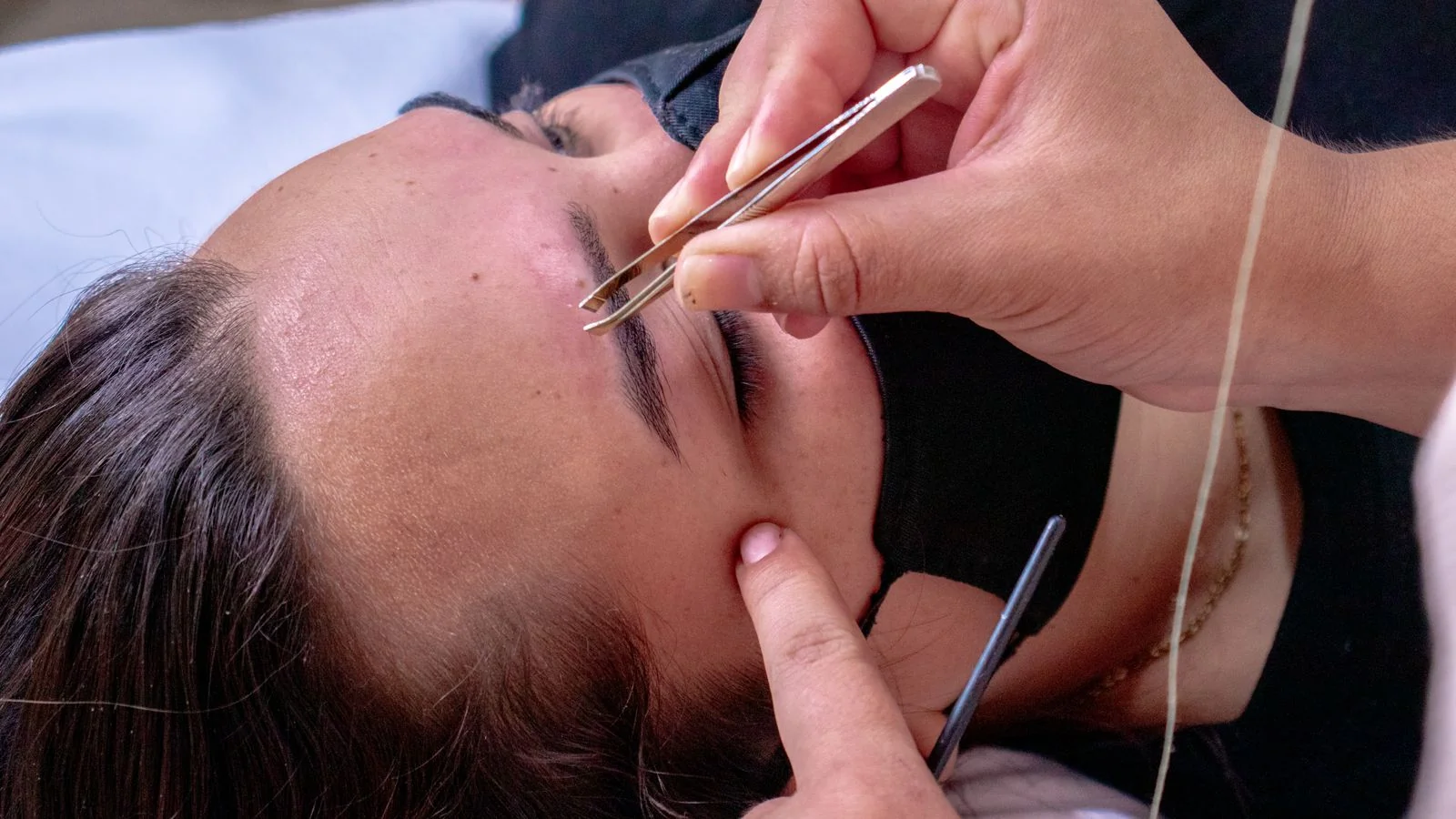
Why does a client drive past four brow bars to reach a fifth?
It is not price, because brow services sit in a narrow band. It is not convenience, obviously, since she drove past four. It is that somewhere along the way she decided that one specific person understands what to do with her face, and everyone else is a risk.
That decision is the entire market. Brows are the highest-stakes low-cost service in beauty, because the downside is not a bad week, it is a bad six months. Eyebrow hair has a shorter growth phase than scalp hair, over-plucked follicles can take many months to recover, and repeated damage can stop them recovering at all. A client knows this in her body even if she cannot explain the biology. So she does not shop for a service. She shops for a person she can trust with something semi-permanent.
Personal branding for brow bars is the work of being that person legibly, before she is in your chair.
Start from the only question she is actually asking
She is asking one thing: will you take too much?
Everything in your marketing either answers that or wastes her attention. A carousel of beautiful finished brows does not answer it, because every brow bar posts beautiful finished brows and she cannot tell whether those clients started with dense hair or whether you removed half of it.
What answers it is restraint made visible. The client who came in asking for a thin arch and left with a shape you talked her into keeping. The correction where you added nothing and removed almost nothing and the change came from mapping rather than tweezers. The honest post about a client whose brows you declined to touch for six weeks because they needed to grow first.
Turning away revenue in public is the most persuasive thing a brow artist can do, and it costs one appointment.
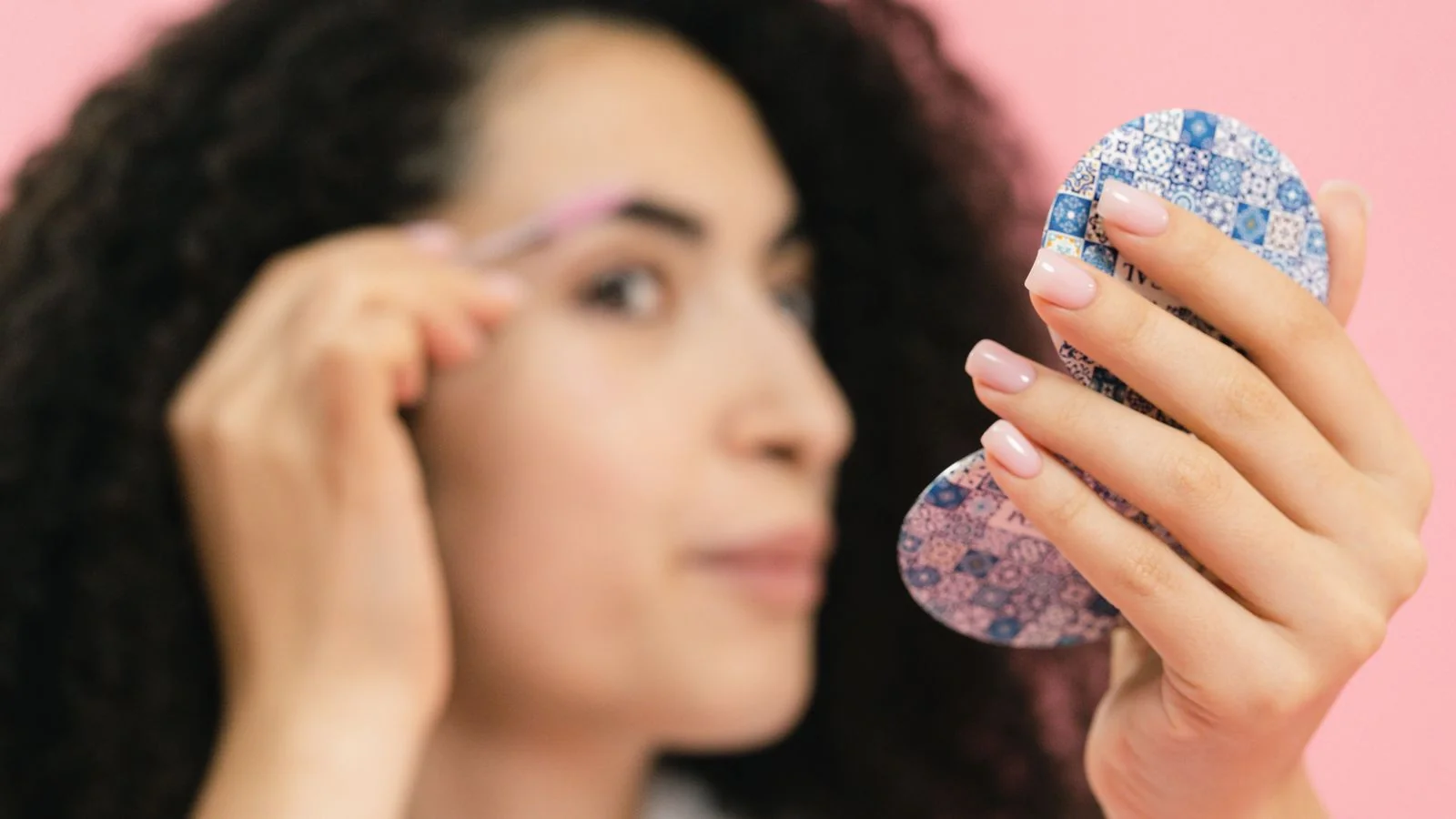
Run the Face-Shape Authority Test on your own marketing
Here is a test I use to audit brow marketing, and most accounts fail it inside thirty seconds. Call it the Face-Shape Authority Test.
Scroll your own feed, your website, and your booking page as a stranger. Then answer three questions.
Can I tell what kind of face you are best with? Not “all faces.” A specific answer. Sparse brows from years of over-plucking. Very dark, very dense hair where the risk is over-correction. Asymmetry from a facial palsy or an old scar. Mature clients whose brows have thinned. Textured, coarse growth patterns that will not lie flat. If the honest answer is that you present as good at everything, you read as a generalist, and generalists compete on price and proximity.
Can I tell what you would refuse? If nothing in your public presence describes a service you decline or a request you talk clients out of, a stranger has no evidence of judgment. Skill is easy to claim. Judgment has to be demonstrated by subtraction.
Can I tell how you decide, not just what you deliver? If your content shows only outcomes, she has to take the outcome on faith. If it shows the measuring, the mapping, the moment you moved the arch three millimetres and explained why, she is watching a professional think, which is a different and much stronger experience.
A brow bar that passes all three is unusual. That is the whole opportunity.
Show the decision, not the result
The single highest-performing content in this category is the mapping sequence, and it is the least posted.
Film or photograph the pre-service face at rest. Show the string or pencil finding the start point, the arch, and the tail. Mark the asymmetry that almost every face has and that almost no client knows she has. Then explain, in one or two plain sentences, what you are going to do about it and what you are deliberately not going to do.
Three things happen. The viewer learns something about her own face, which makes the content worth watching rather than worth scrolling. She sees measurement, which converts a beauty service into a technical one in her mind. And she now has a reason to want you specifically, because she watched you make a call that a less careful person would not have made.
If you never want to appear on camera, none of this requires it. Hands, a pencil, a face that is not yours, and captions are enough.
Own the regrowth conversation before someone else does
Every brow bar inherits clients damaged by a previous one, and almost nobody talks about it publicly, which leaves a large, uncontested topic sitting there.
Explain what actually happens to an over-plucked brow. Explain the realistic timeline, which is long and which clients consistently underestimate. Explain what serums can and cannot do. Explain when lamination is a good idea for a sparse brow and when it is a way to disguise damage that will get worse. Explain the difference between a service that reshapes hair you have and a cosmetic tattoo procedure like microblading, which in many states is regulated as body art rather than cosmetology and carries bloodborne pathogen training requirements.
Being the person who explains the honest timeline costs you a few immediate bookings and earns you the ones that matter, because a client who trusts your timeline trusts everything downstream of it. It also makes you the obvious source for any local reporter writing about cosmetic tattooing regulation, which is the cheapest legitimate press available in this industry.
Price like a specialist, not from a menu
A brow bar with a personal brand and a commodity price list is fighting itself, and the price list usually wins.
The problem with menu pricing in this category is that it invites comparison on the only axis where you cannot win, which is cost per service. A fifteen dollar wax is a fifteen dollar wax. The client who books on that number will leave for a twelve dollar wax, and she will not feel bad about it, because nothing in the transaction told her there was anything else to consider.
Specialists price the first appointment differently from the maintenance appointment, and they say why. The first visit includes mapping, a shape decision, and a plan, and it takes longer and costs more. Subsequent visits maintain a shape that already exists. That structure communicates something true: the value is in the decision, not in the hair removal, and the decision happens once.
It also solves a business problem. Brow services are low-ticket and appointment-dense, which means your ceiling is hours in the day. A first-visit consultation fee, a correction programme priced as a course of appointments rather than one at a time, and a maintenance rate for people on a schedule, all of that raises the average without adding chairs.
The clients who object to this pricing are, without exception, the ones who were going to leave anyway. The clients who understand it immediately are the ones with damage to fix, which is your best and most loyal segment.
State the prices publicly. A brow bar that hides pricing reads as a brow bar that will surprise you, and surprise is the thing this client is already afraid of.
Where brow artists waste their marketing money
Three places, consistently, and all three feel productive.
The first is paid promotion of finished-brow photos. You are spending money to put an image in front of strangers that tells them nothing they can evaluate, in a feed full of identical images. If you are going to spend, spend it promoting the mapping content or the regrowth guide, because those change a stranger’s mind and a finished brow does not.
The second is discounting to fill quiet weeks. A discount brings in a client who is buying a price, and it trains your existing clients to wait for the next one. If you have quiet weeks, the problem is almost always that nobody is being reminded at day twenty-five, and a message to your own list costs nothing. Fix the reminder before you touch the price.
The third, and the most common, is spreading thin across four platforms. A brow artist posting mediocre content to Instagram, TikTok, Facebook, and Pinterest simultaneously produces less than one posting well to a single platform plus one genuinely good page on her own website. Pick the platform where your clients already are, which in this category is usually Instagram, and put everything else into the site, because the site is the part you own and the part that gets cited when somebody asks an assistant for a recommendation.
The underlying error in all three is treating marketing as volume rather than as evidence. You are not trying to be seen more often. You are trying to give one anxious person enough evidence to trust you with her face.
Seven moves that book you out
One, name your specialty in the first line of every profile. Not “brow artist.” “Brow artist for sparse and over-plucked brows” is a different business.
Two, publish one refusal. A service you do not offer, a request you talk clients out of, or a condition under which you send someone home to grow hair first. Put it where a stranger will see it.
Three, name your mapping method. If you approach shape in a consistent, describable way, give it a term and define it the same way every time. Named methods get repeated by clients, requested by name, and surfaced by answer engines, which need a noun to attach a recommendation to.
Four, post one mapping sequence a week. Process, not portfolio.
Five, put your name and specialty on pages you do not own. A quote in a local piece about cosmetic tattooing rules, a named profile on an industry directory, a guest appearance where someone else introduces you. Independent mentions carry weight that your own account never will, with clients and with the systems that now answer “who is the best brow artist near me.”
Six, write the regrowth guide. One long, honest page on your own site about damage and recovery timelines. It will quietly become the most-read thing you publish and the reason strangers arrive already convinced.
Seven, ask clients to describe you, not rate you. “How would you explain what I do to a friend?” produces the sentence you should be using in your own marketing, and it will be better than anything you write yourself.
The commercial proof of all this is not subtle. Anastasia Soare built Anastasia Beverly Hills out of a brow-shaping practice and a named approach to proportion, and the company that followed was possible because the method and the person came first. The brand did not create the authority. The authority created the brand, and it started with one artist being known for a specific way of looking at a face.