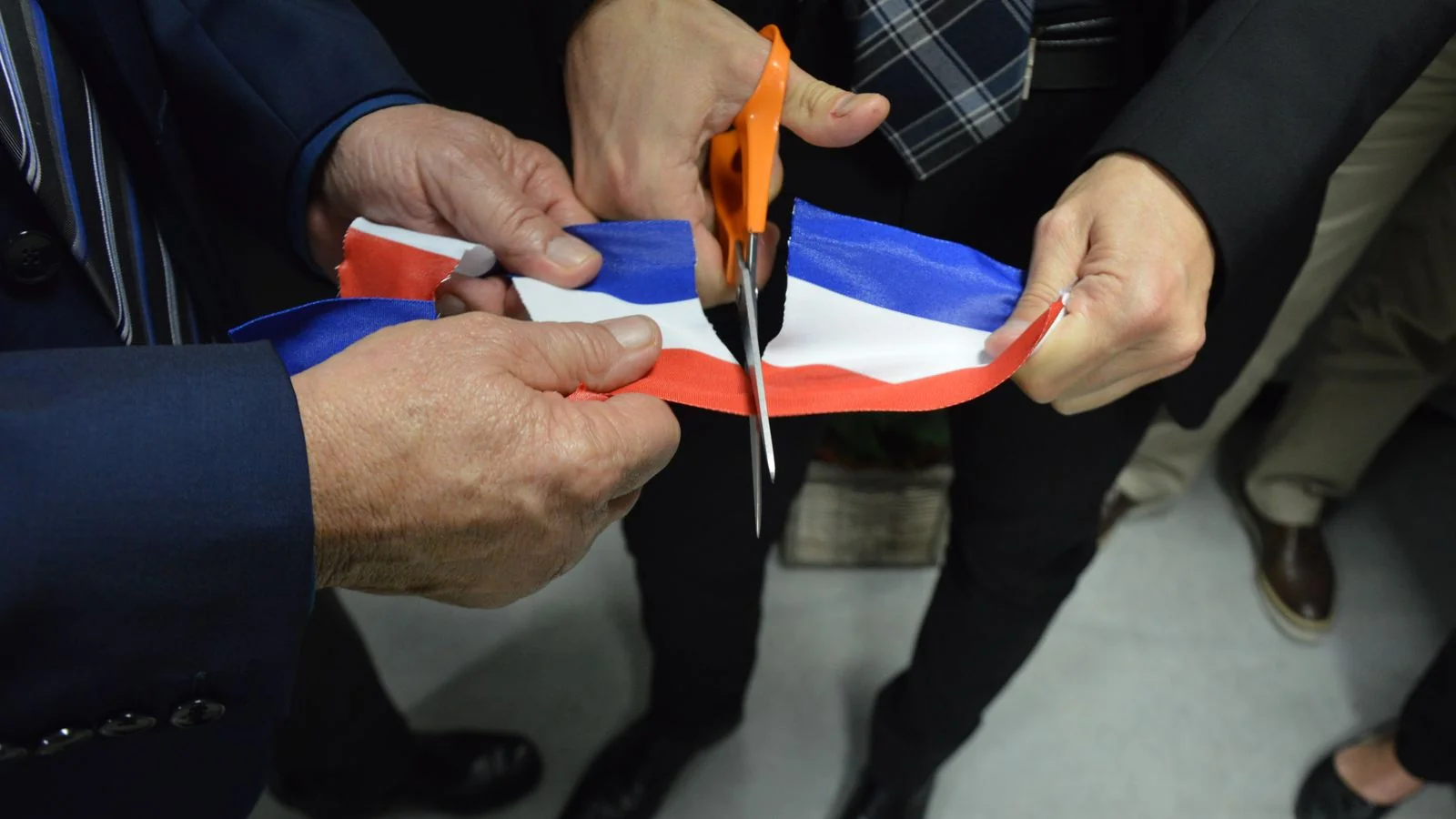
Opening a business is the most important day of your year and one of the least interesting things that will happen in your town that week. Both are true at once, and the gap between them is why most grand opening coverage never materialises.
A grand opening press release that works does not announce an opening. It uses an opening as the occasion for a story an editor already wanted. That reframe is the whole craft, and it costs nothing except the willingness to write about something other than yourself.
Opening a business is not a story
Put yourself at the local news desk for a moment. Somewhere between four and fifteen businesses open in your coverage area every month. Each one sends a release describing an exciting new addition to the community, a ribbon cutting at 10am, and a quote from the owner about being thrilled.
They are indistinguishable. The editor is not hostile to small business; they are looking at a stack of identical documents and no basis for choosing between them. What gets published is whichever one contains something that is not in the other fourteen.
This is why the standard advice to include high-resolution photographs and a compelling quote does not help. Everyone does that. Differentiation has to come from the substance of what you are claiming, not the production quality of the claim.
It also explains the most common disappointment in this category. A business spends real money on a wire distribution, sees the release appear on twenty syndication sites, and concludes they got coverage. They did not. They got republication, which generates no readers, no customers and no local relationships, and which an experienced eye reads as the opposite of earned coverage.
The outlets that matter for an opening are local and specific: the city paper, the neighbourhood publication, the regional business journal, the local broadcast morning show, the two or three food or retail newsletters people in your area actually read. There are rarely more than eight of them, and each one needs a different reason to care.
Three angles that convert an opening into news
Three framings reliably work, and a strong release uses whichever one is genuinely true rather than attempting all three.
The first is the vacancy angle. If you are taking a space that has been empty, or that held a business people remember, the story is about the building rather than about you. Local editors cover empty storefronts as a running concern, and a filled one is a development in that ongoing story. The release leads with the address and its history: how long it sat empty, what was there before, what the street looks like now. Your business becomes the resolution of a question the publication has already been asking.
The second is the person angle. Not that you are an entrepreneur, which describes everybody, but something specific and verifiable about the path. A line cook opening their own place after nineteen years in other people’s kitchens. A pair of siblings reopening a trade their grandfather ran in the same town. Someone who moved back after a decade away. Local journalism runs on people, and a biographical fact that can be stated in one sentence is worth more than any description of your concept.
The third is the category angle. If your opening represents something new to the area, that is a trend story with your opening as the news hook. The first of its kind in the county, the third specialty roaster to open in eighteen months, a service people currently drive forty minutes for. Note that the third variant works even when you are not first. Being the third instance of something is what makes it a trend, and a reporter who has noticed two others has been waiting for the third.
If none of the three apply honestly, the realistic assessment is that your opening is not a news story and your effort belongs in local partnerships and paid promotion instead. That is an uncomfortable conclusion and it is better reached before you spend three weeks on outreach.
Write the release in this order
The sequence below puts the newsworthy element first and the opening second, which inverts how almost everyone drafts these.

The headline carries the angle, not the opening. Compare two versions of the same announcement. Marino’s Bakery Celebrates Grand Opening on Carter Street tells an editor nothing. Carter Street’s Longest-Vacant Storefront Reopens as a Bakery After Six Years tells them the story and the opening both. The second headline can be published unchanged, which is the standard to write to.
The first paragraph gives the five facts in plain sentences: the business name, what it does, the address, the opening date, and the angle stated explicitly. Keep it under sixty words. Many small outlets will publish only this paragraph, so it has to work alone.
The second paragraph develops the angle with specifics and numbers. If it is the vacancy angle, say how many years, what was there before, and what the renovation involved. If it is the person angle, give the years of experience, the previous employer, the detail that makes the biography concrete. Specificity here is what separates a story from a notice, and vagueness at this point is usually a sign the angle is not real.
The third paragraph is the owner quote, and it should contain information rather than emotion. Thrilled, excited and proud to serve the community are words that get cut by every editor who receives them. A quote that says something a reader did not know survives. Describe a decision, a difficulty, a thing you learned about the neighbourhood while fitting out the space.
The fourth paragraph covers the practical details a reader needs to act on: opening hours, what the opening day involves, parking, whether there is anything happening that a family could turn up to. This paragraph is what converts coverage into customers, and it is the one most often left out because it feels promotional. It is not. It is service information and editors want it.
The fifth paragraph is the business basics for the record: how many people you employ, the investment if you are comfortable stating it, how long the fit-out took, any local suppliers or contractors you used. Local business desks care about employment numbers more than anything else in the document, and naming local contractors frequently produces a second story in their trade coverage.
Then the contact block: a named person, a mobile number answered the same day, and a note that photographs and interviews are available before opening day. That last line matters because a reporter planning coverage wants to visit while the space is empty and the story is unspoiled, not during a crowded opening.
Keep the whole thing under 450 words. A longer release does not get read further; it gets skimmed less carefully.
The follow-up nobody sends
Most of the available coverage sits after opening day, not before it, and almost nobody goes back for it.
A grand opening press release is a one-shot document and editors treat it that way. What they will take, two to four weeks later, is a short email containing a result: how many people came, what sold out, what surprised you about the neighbourhood. This is a different story with a different news value, and it reaches outlets that passed on the opening because openings are not news.
The second follow-up window is the anniversary, and it is the most reliably underused opportunity in local business coverage. One year in business, with twelve months of numbers behind it, is a story local editors genuinely want, because it answers a question readers have about whether new businesses survive. Put a reminder in the calendar on opening day.
The third is the seasonal hook. Whatever you sell connects to something on the local news calendar, and a business that is three months old is a fresh voice on it. A grand opening press release gets you into the file; the seasonal follow-up is what keeps you there.
What to do on opening day itself
The release is one half of the work. The other half is making the day produce material, because coverage frequently arrives after an opening rather than before it, and a reporter writing a follow-up needs something to look at.
Photograph the day properly. Not phone snaps of a crowd, but a small set of usable images: the exterior with signage and people in frame, the owner at work rather than posed, and one detail shot that explains what the business does. Horizontal framing, no filters, files large enough to print. Most local outlets will run a photograph supplied by the business if it is good enough, and most supplied photographs are not, which is a cheap advantage to take.
Collect the numbers as the day happens. How many people came through, how many of the opening-day items sold out, how far the furthest customer travelled. These seem trivial on the day and they are the raw material of the follow-up pitch a week later: a line saying four hundred people came through the door on Saturday is a fact an editor can use, and a fact is what turns a second approach into a second story.
Invite the people who make the second story possible. The council member whose ward this is, the neighbourhood association contact, the owner of the business next door. None of them generate coverage directly, and all of them are the people a reporter calls for a quote about the street. Being the business they speak warmly about is worth more than any line in your own release.
Finally, keep the ribbon-cutting short and schedule it early. Mid-morning works because it fits a reporter’s day and a broadcast crew’s turnaround. A four o’clock ceremony is an event for your friends, not for coverage, and knowing which one you are holding is worth deciding deliberately rather than by accident.
Where should it actually go?
Send it to eight named people, not to a list.
Build the list by reading rather than buying. Find the reporter who covered the last three business openings in your area and note their name. Find whoever writes the regional business journal’s expansion and openings column, which exists in almost every market and is perpetually short of material. Find the producer who books local morning television segments, since a new food business with something visual to demonstrate is exactly what those slots need. Find the one or two neighbourhood newsletters or community accounts with genuine local readership, which in many areas now outperform the paper for reach among people who live within a mile of you.
Send individually, with a one-line note at the top of the email saying why this particular person would want it. Fifteen words. Saw your piece on the Carter Street vacancies in March, this is that building. That single line is the difference between a pitch and a mailshot, and it takes two minutes per recipient.
Timing is two to three weeks ahead of opening, with a short follow-up three days before. Earlier than that and it sits in a queue; later and the calendar is set. Weekly publications need longer, monthly ones need six weeks, and broadcast morning shows often prefer four or five days of notice rather than three weeks.
On distribution services, be clear about what you are purchasing. Wire syndication puts your release on aggregator sites and generates URLs. It does not put you in front of the eight people above, and no amount of syndication substitutes for the two-minute personal email. There is a legitimate role for paid placement in building a searchable record of the business, which matters when customers and suppliers check you later, but it belongs in a different budget line from the one labelled launch coverage. Across the publication catalogue we work with at Instant Press, around 96% are Google-indexed, and that indexing is the actual product of a paid placement: a durable search result, not an audience.
So the whole thing compresses to this. Find the true angle or accept there is not one. Lead with the angle and put the opening second. Write under 450 words, include the employment number and the opening hours, and quote yourself saying something rather than feeling something. Then send it to eight named people with one personal line each, three weeks out. That is a morning’s work and it beats a thousand-dollar wire release every time.