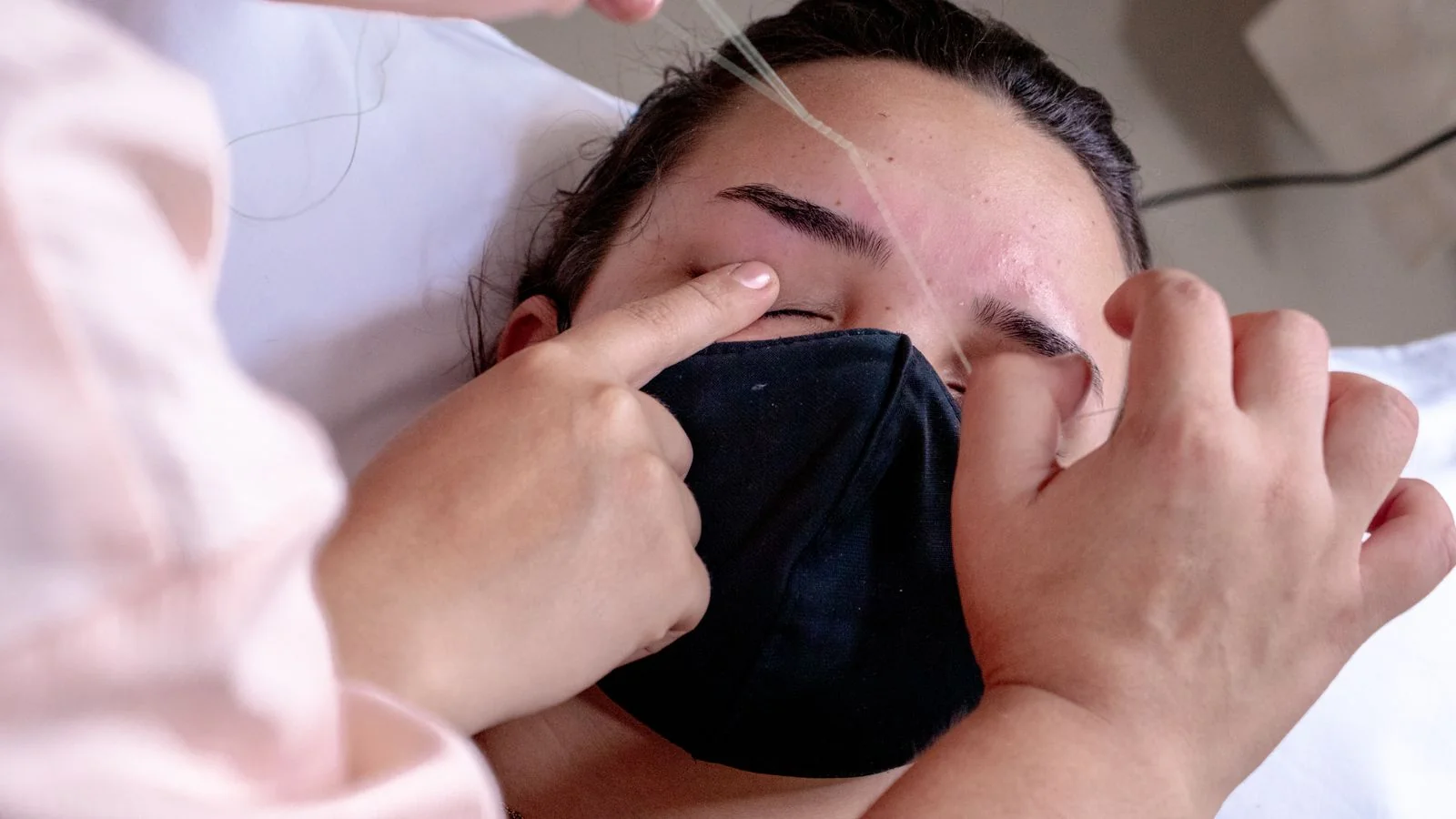
It is Tuesday night and you are looking at your camera roll trying to decide what to post. There are forty finished brow photos. They all look good. They all look roughly the same. You pick one, write “loving this shape on her,” add six hashtags, and post it, and it does what the last one did, which is nothing.
The problem is not the photo and it is not the caption. It is that the post has no idea where the person seeing it is in her own brow cycle, and a brow client’s willingness to book is almost entirely determined by that.
Your best content is a calendar problem, not a creative one
Brow services run on a cycle. Waxing and threading clients typically return every four to six weeks as growth comes back. Lamination holds longer, commonly six to eight weeks. Tint fades on skin within a few weeks and lingers on the hair. Whatever your service mix, your clients are moving through a predictable arc and arriving at predictable emotional states.
Week one, she loves them and is not thinking about you at all. Week three, she is starting to see stray hairs and is deciding whether to tweeze at home, which is the moment your business is either won or lost. Week five, she looks overgrown and books someone, and it may or may not be you.
Almost every brow bar posts as if every viewer is at week one. Beautiful afters, aimed at a person who currently has beautiful brows and needs nothing.
That is the entire failure. Fix the timing and the same photos start working.

The Regrowth Cycle Calendar
Here is the model. Call it the Regrowth Cycle Calendar. You build one six-week content loop, mapped to the three windows above, and then you run it on repeat forever because your clients are always distributed across all three.
The logic is simple and most operators miss it. You are not building a feed for an audience that consumes it in order. You are building a standing library that catches people at the moment their own face pushes them toward a decision. Because clients are staggered, a post aimed at week three is landing on a fresh group of week-three people every single week.
Three windows, three jobs. Week one is retention and referral. Weeks two to four are doubt management, which is where you stop her tweezing at home. Weeks five and six are conversion, where you make rebooking frictionless and obvious.
Build roughly six to nine pieces per window. That is your library. Then rotate, refresh a third of it each quarter, and stop staring at your camera roll on Tuesday nights.
Week one: the aftercare window
She is happy. Your job is to convert that into two things: protection of the result, and a referral.
Aftercare content does the first. What to avoid for twenty-four hours after wax, why heat and exfoliants matter, what to do if there is redness. This is dull to write and it prevents the complaints that turn into reviews. Send it as a message as well as posting it, because the client who needs it most is not scrolling.

Referral content does the second, and it works best when it is not an ask. A post that says “if someone compliments your brows this week, the shape is called a soft arch and it is mapped to your eye, not copied from a photo” gives her language. Clients refer when they have words, not when they have a discount code. Give her the words.
This is also the window for the pretty afters, since they are finally aimed at the right person. Post them here, tag the client if she consents, and let her share.
Weeks two to four: the doubt window
The most valuable and most neglected window in the entire calendar.
She is seeing regrowth. She has tweezers in a drawer. Every hair she removes at home in this window is a hair that will not be there to shape at her next appointment, and a client who over-tweezes between visits will slowly become a client who thinks you are not very good.
So the content here has one job: stop her touching them, and make her feel informed rather than scolded.
Explain what regrowth actually looks like at day fourteen versus day twenty-one, with photographs, so she can compare her own face against a reference and see that she is normal. Explain why stray hairs below the arch are usually load-bearing and why removing them narrows the shape permanently over time. Explain the honest recovery timeline for over-plucked brows, which is long, and which almost nobody publishes because it is not a flattering fact.
This is the window for your longest and best written content, and it belongs on your own site rather than only on social. A thorough page about over-plucked brow recovery is the kind of thing people search for at eleven at night, share with a friend, and arrive at your studio already having read. It is also exactly the kind of page an answer engine can cite when someone asks an assistant how long brows take to grow back, because it is specific, consistently worded, and answers one question completely.
The strategic point is worth stating plainly. Content that keeps a client’s hands off her own face is worth more than content that shows your work, because it protects the raw material you need in order to look good in six weeks.
Weeks five and six: the rebooking window
Now she is overgrown, she knows it, and she is going to book something. Your only job is to be the easiest option in her field of view.
The content here is short and practical. Availability. What a maintenance appointment involves and how long it takes. A reminder of the one thing you are known for, which should be the same sentence every time. A before and after where the before is at week six rather than at year one of neglect, so she recognises her own current face in it.
Do not introduce new ideas in this window. A client at the decision point does not want education, she wants a button. Most brow bars have this backwards and put their most elaborate content here, where it functions as friction.
The other move that belongs here is the direct message. It is not content marketing in the strict sense and it outperforms everything above. A short message at day thirty-five, personal, referencing her actual shape, with two available times. Nothing on your grid will convert like that.
What belongs on your site and what belongs on social
These are two different tools doing two different jobs, and brow bars routinely use one for both.
Social is a retention instrument. It reaches people who already know you exist, keeps you present during the doubt window, and gives existing clients something to share. It is rented ground, the reach is decided by somebody else’s algorithm, and a post has a useful life measured in days. That is fine, because retention is a recurring job and recurring jobs suit a recurring format.
Your own website is an acquisition and citation instrument. It reaches people who do not know you exist but who are searching a problem. A page published there keeps working for years, accumulates rather than expires, and, unlike a post, can be found, read, and quoted by the systems that increasingly answer beauty questions on a customer’s behalf.
So the split is straightforward. Everything time-bound and relational goes on social: mapping clips, aftercare reminders, availability, client shares, the doubt-window nudges. Everything durable and question-shaped goes on the site.
Four pages will carry a brow bar for years. A thorough page on over-plucked brow recovery, with honest timelines. A page explaining the difference between shaping, tinting, lamination, and cosmetic tattooing, including which are regulated as body art in your state and what training that requires. A page on what to expect at a first appointment, written for someone who has been let down before. And a page defining your own mapping approach in consistent language, so the term you use is attached to something a machine can read.
That last one is doing more work than it appears to. An answer engine producing a recommendation needs a describable entity. If your method is named the same way on your site, your profile, and anywhere else you appear, that repetition is what turns a phrase into something the model can attach to you. If your site says “we offer brow services in a relaxing environment,” there is nothing there to attach.
Write these once. Refresh the photographs annually. Link to them from your social bio and from every relevant post. They will quietly outperform several years of daily posting, and unlike the posting, they do not need you to keep showing up.
One practical warning about the split. Do not simply copy a social caption onto a page and call it a blog post. The two formats want opposite things. A caption works because it is compressed, assumes context, and is read by somebody who already follows you. A page works because it is complete, assumes nothing, and is read by a stranger who arrived from a search with one specific question.
The test for a page is whether it fully answers its question without requiring the reader to book, message you, or already know who you are. If the honest answer to “how long do over-plucked brows take to grow back” is on your page in plain language with a real timeline, you have written something useful. If the page says “book a consultation to find out,” you have written an advertisement, and neither a reader nor an answer engine has any reason to carry it further.
Give the answer away. The client who reads the honest timeline and decides she needs professional help is worth more than three who were tricked into a booking, and she arrives already trusting you.
Build the library once, then run it forever
Block four hours. Not four hours a week, four hours once.
In that block, shoot six mapping sequences back to back with different clients across a normal working day, capturing the measurement and the reasoning rather than the result. Photograph three clients at the two-week mark and three at the five-week mark, with permission, so you have honest regrowth references. Write the single long recovery page for your own website. Draft nine captions, three per window, and save them somewhere you can reach on a Tuesday night.
That is the library. It covers the cycle, it does not expire, and the only ongoing work is rotation and the occasional refresh.
Start with one thing this week: open your booking system, find every client sitting at day eighteen to twenty-five, and post the doubt-window piece about why the hairs under the arch should stay. That single post, aimed at the people who are right now holding tweezers, will do more than the last month of finished-brow photos combined.