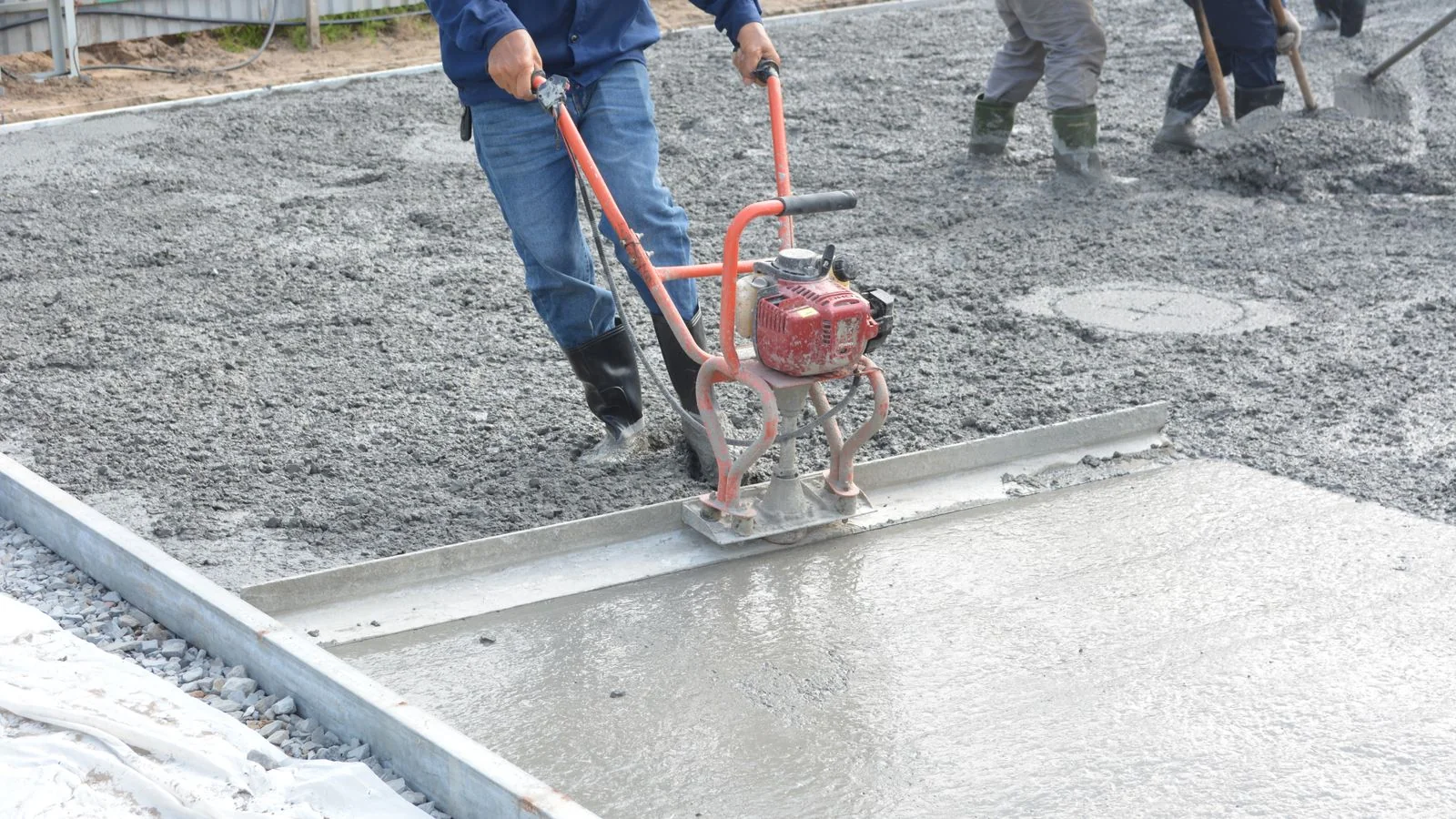
How does a concrete contractor build a personal brand? You turn the most permanent product in the trades into a permanent record of your work, attach your name to it, and let that record do your selling for years. That is the short answer, and it is a bigger advantage than it sounds, because almost no concrete contractor does it. They pour beautiful, decade-lasting work and then let it vanish into anonymity the moment the check clears.
Think about the waste in that. Your finished driveway, patio, or stamped walkway will sit in plain view for fifteen or twenty years. It is durable, photogenic proof of your skill, and most contractors never photograph it, never claim it, and never connect it to their name. Personal branding for concrete contractors is really just the discipline of stopping that waste, of making sure the work that lasts also markets you for as long as it stands. Here is how to do it.
Concrete is permanent, so your proof should be too
Most trades produce work that is either hidden or temporary. A concrete job is neither. It is on display, in daylight, for years, which makes it the ideal foundation for a personal brand built on visible proof. The contractor who understands this treats every completed pour not as a finished transaction but as a permanent exhibit, and the difference in how they market shows within a season.
The buyer you want is looking for exactly this kind of evidence. Concrete is expensive, unforgiving, and impossible to redo cheaply, so the homeowner or builder choosing a contractor is terrified of picking wrong. A vague promise does not calm that fear. A deep, visible body of finished work, tied to a real person who stands behind it, does. When a prospect can scroll through dozens of your actual jobs and watch you explain how you approached each one, the decision stops feeling like a gamble.
This is why the permanence of concrete is a marketing gift most contractors leave unopened. The work already lasts. Your job is to make sure the record of it, and the name attached to that record, lasts just as long and stays just as visible. Do that and you stop starting from zero on every bid, because your reputation is already sitting in a hundred driveways across your service area.
There is a compounding quality to this that most trades never get to enjoy. A landscaper’s best work grows over and changes with the seasons. A painter’s fades and gets redone. Your concrete sits there, unchanged and photogenic, for a generation. That means every job you document does not just market you this year. It keeps marketing you for as long as the slab exists, which for good concrete is decades. The contractor who understands this stops thinking of marketing as an expense that resets each month and starts thinking of it as an archive that only grows. Ten years in, the paver who documented nothing is still buying leads, while the one who captured every pour has a library of proof so deep that new clients arrive already convinced.
The Set-in-Stone Portfolio
Here is the model that organizes the whole effort. Every pour you complete is a permanent, photographable asset that can be captured once and used forever. Build a deliberate, growing, documented collection of that work under your own name and you have what I call the Set-in-Stone Portfolio: an accumulating body of proof that gets stronger with every job and that a competitor cannot fake, borrow, or catch up to quickly.
The Set-in-Stone Portfolio works because it compounds. The contractor who photographs and posts every finished job for two years ends up with an unarguable archive, while the one who posts nothing is still explaining, on every estimate, why they should be trusted. Each documented pour adds to the pile of evidence, and the pile itself becomes the reason buyers choose you. It is the single highest-return habit in the whole play, and it costs only the two minutes it takes to shoot the work before you leave the site.
Building it is simple in principle and requires only consistency in practice. Capture the arc of each job, the prep and forms, the pour, the finishing, and the cured result in good light. Add a short clip of yourself explaining one choice you made, why you used a particular finish, how you handled drainage, what the client wanted and how you delivered it. Tag it with the location and the type of work. Over months, that archive becomes a searchable, browsable record that proves your range and your standards better than any sales pitch. Personal branding for concrete contractors lives or dies on whether this portfolio exists, because it is the concrete evidence, literally, that every other part of the brand points back to.
Put yourself on camera explaining the craft
A portfolio of finished work proves what you made. Video of you explaining it proves who you are, and buyers need both. Pull out your phone on the job and talk through what you are doing in plain language. Explain why you are pouring in the morning heat or waiting for it to pass, why the base prep matters more than the finish everyone admires, how you control cracking, what separates a slab that lasts from one that spiders in two winters. You are not performing. You are letting people watch a craftsman work and hear that he knows exactly what he is doing.
Roughness helps here rather than hurting. A clip shot on a phone, with real dust and real noise and an owner who is clearly more comfortable with a trowel than a camera, reads as authentic in a way a polished ad never will. Concrete buyers are wary of slick operators who overpromise, so the plain, competent, slightly awkward human face is a feature. It signals that you spend your time on the work, not on the marketing, which is precisely what they want in someone pouring something they will live with for twenty years.
Post those clips alongside the portfolio, on your Google profile, Facebook, Instagram, and anywhere local buyers gather. The combination is what does the work: the finished results show the outcome, and the videos show the mind and hands behind them. Together they turn an anonymous bid into a known craftsman, which is the entire point of personal branding for concrete contractors.
If you freeze on what to say into the camera, narrate the decisions you make without thinking. Why you are dampening the subgrade before the pour. Why you are placing control joints where you are, and what happens if someone skips them. Why the finish you chose suits this client’s use and climate. Why you are covering and curing the slab instead of walking away once it looks hard. Each of these is a thirty-second explanation you could give in your sleep, and each one quietly proves to a watching buyer that you understand things the cheap competitor does not. You are not teaching a masterclass. You are letting people overhear a professional think, and that is more persuasive than any claim you could make about yourself.
How do you get found when someone searches your name?
A prospect who watched your video or got your name from a neighbor will do one thing next: search you. What they find in that moment decides whether the trust you built survives. If your name returns a coherent, consistent picture, a complete profile, aligned details, your portfolio, and real reviews, the trust holds and often deepens. If it returns nothing, or a jumble of mismatched listings, the doubt creeps back in.
So claim and align your presence everywhere it matters. Complete your Google Business Profile fully, keep your name, service area, and phone number identical across every directory, build a simple site with an About page that carries your real photo and story, and keep your social profiles active under one consistent name. The goal is a single, clear identity that anyone can verify in thirty seconds.
That consistency also feeds the machines now answering buyers’ questions. When a homeowner asks ChatGPT or Google’s AI for a trusted concrete contractor in your area, those systems reach for well-defined entities with clear, corroborated footprints. A contractor whose name, work, and reviews all line up is easy for a model to recognize and name. A scattered or invisible one gets passed over, no matter how good the actual concrete is. Getting found, by people and by AI, is what converts your brand from a nice idea into booked jobs.
The mechanics here are not complicated, they just require follow-through. Search your own name the way a prospect would and see what comes back. If it is a mess, or worse, nothing, that is your first project. Claim the empty profiles, correct the mismatched ones, and make sure the same photo, the same story, and the same contact details greet anyone who looks, whether they find you on Google, a directory, or a social feed. Then keep it current. A profile that shows a job from last week reads as an active, in-demand craftsman. One frozen two years ago reads as a business that may not even exist anymore. In a decision this expensive and this permanent, a buyer will always choose the contractor who looks present and verifiable over the one who leaves them guessing.
Let clients and press vouch for you
Everything so far is proof you create about yourself, and it is powerful, but the strongest layer comes from others. Reviews that mention you by name and describe the specific job, a referral that arrives already trusting you, a feature in a local paper or a spot on a regional home segment, each is outside validation that the craftsman in your videos is exactly who he appears to be. Gather that proof deliberately and put it where buyers will see it.
Make the ask a habit. When a client is standing on their finished patio, visibly pleased, that is the moment to request a review and to ask, gently, that they mention what you built. Those specific, named reviews persuade the next reader and feed the language AI tools reuse when recommending you. Pursue local coverage too, since a trade built on permanence and craft has natural stories a community paper will run, from a standout decorative project to a piece of work that solved a hard site problem. Layer that third-party proof on top of your Set-in-Stone Portfolio and your personal brand stops resting on your own word alone.
So here is the question worth sitting with. Every job you have finished this year is already out there, permanent and visible, working for someone. Is it working for you, with your name on it and your story attached, or is it just another anonymous slab that a competitor’s marketing will get the credit for? The concrete is going to last either way. The only choice is whether your reputation lasts with it.