
When we rebuilt the Instant Press site, the page that moved actual revenue was not the homepage with the polished positioning. It was a plain page showing real publication placements with real numbers attached. Prospects would land, skim the claims, and click straight to the proof. The lesson transferred to every portfolio review we have done since: visitors do not believe what you say about yourself, they believe what they can inspect. That principle, proof before polish, is the spine of this portfolio website guide.
It also explains why so many beautiful portfolios fail commercially. The template era made gorgeous sites cheap, so beauty stopped being a differentiator. What buyers cannot get from a template is evidence: the case studies, the outcomes, the thinking. Structure the site to lead with those and you outperform competitors with twice your visual budget.
Page 1: a home page that answers three questions in five seconds
The visitor arrives knowing nothing. The home page has one job: answer who you are, what you do, and for whom, above the fold, in plain words. “Brand designer for early-stage fintech” beats “Crafting digital experiences” in every test anyone has run, because the specific phrase lets the right visitor self-identify and the vague one lets everyone bounce equally.
Below the fold, the home page becomes a sampler: two or three featured projects with outcomes in the captions, a one-line bio with a face, and a single call to action. Resist the urge to put everything here. The home page is a router, not a warehouse.
The five-second standard is not a metaphor, so test it literally. Show the page to someone outside your field for five seconds, take it away, and ask what you do and who you do it for. If the answer is wrong or vague, the page failed, no matter how the design committee feels about it. Repeat after every major edit. This single test, run with three people, replaces most of the agonizing that goes into homepage copy, because it converts taste arguments into pass-fail data.
Page 2: a work page built like a menu, not an archive
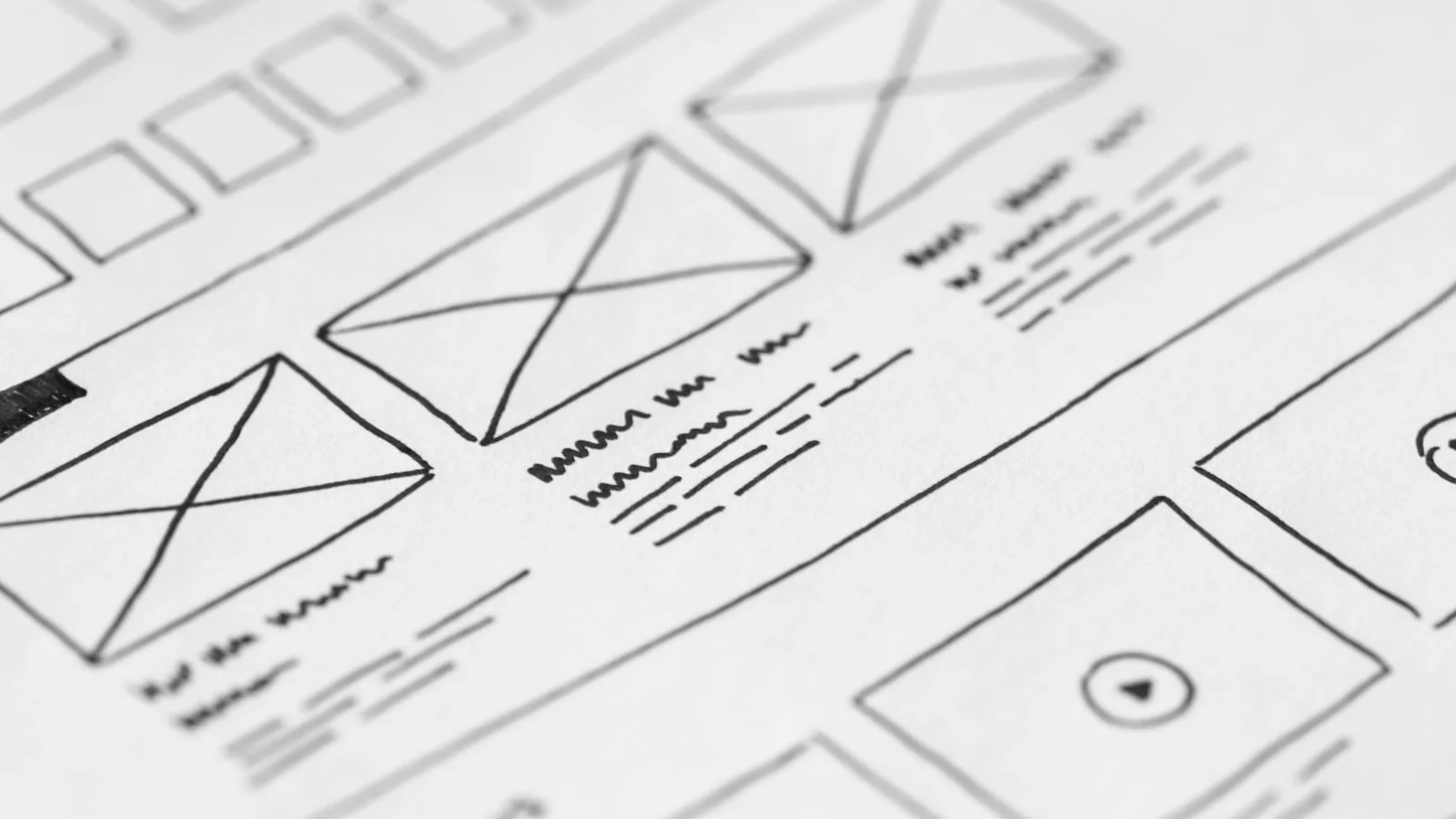
Three to six projects, full stop. Each entry needs a thumbnail, a client or project name, a one-line description of what kind of problem it was, and one number or outcome if you have it. The work page is where the proof-first layout shows its teeth: a visitor should be able to read only the captions and still come away knowing what you are good at.
Curate for the work you want, not the work you have. A portfolio full of restaurant logos attracts restaurant logo projects. If you are pivoting to product design, lead with your two product projects even if the restaurant work is more plentiful, and let the old category compress into a single “other work” mention or vanish.
Order the entries by relevance to your target client, not chronology, because the first two thumbnails get most of the clicks and the bottom row gets almost none. Heat-map data from portfolio reviews shows the pattern over and over: visitors open one or two case studies, skim a third, and decide. Your strongest, most representative project belongs in position one even if it is three years old, and the recency anxiety that pushes last month’s mediocre project to the top is a tax on every future inquiry.
Page 3: case studies that show judgment, not just outputs
The case study page is where hiring decisions actually happen, and the format that converts follows a simple arc: context (who the client was and what was broken), constraint (budget, timeline, politics, whatever made it hard), approach (the two or three decisions you made and the reasoning), and result (numbers if possible, a client quote if not, the honest qualitative outcome at minimum).
Notice what that arc sells. Anyone can show finished screens; the case study sells the decision-making in between, which is the thing the client is actually hiring. Keep each study under 800 words, make the images carry the chronology, and write the result section first when drafting, because if a project has no statable result it may belong in the archive rather than the portfolio. A portfolio website guide that skips this page is teaching decoration, not selling.
Two objections come up every time, so handle both here. NDA work: you can almost always describe the problem shape, your role, and the outcome class without naming the client (“a top-ten grocery chain” carries the weight), and a one-line note that details are under NDA reads as professionalism, not evasion. Thin results: early-career portfolios can substitute rigor for scale. A self-initiated redesign with documented reasoning, a before-and-after with honest metrics from a tiny project, or a teardown of a public product all demonstrate the judgment the case study format exists to sell. What kills credibility is not small numbers. It is the absence of any reasoning a buyer can inspect.
Page 4: an about page that is secretly a sales page
Nobody reads about pages for biography. They read them to answer one question: what would this person be like to work with? So write to that. How you run projects, what you believe about your craft, what clients consistently say about working with you, and one or two human details that make you memorable in a stack of candidates. The professional headshot matters less than the paragraph that sounds like an actual person wrote it.
This is also the page where credentials go to support, not lead. A list of past employers and awards earns a compact strip near the bottom. Leading with them reads as resume, and resumes get filed, not hired.
Testimonials do their best work on this page too, and placement beats volume. One specific quote (“she caught a positioning problem we had argued about for a year, in the first call”) placed beside the paragraph describing how you work converts better than a wall of ten generic praise blocks on a dedicated page nobody visits. Collect them with a pointed ask: instead of “would you write a testimonial,” try “what is one thing about working together you would tell someone considering hiring me?” The narrower question produces the concrete sentence; the broad one produces “great to work with, highly recommend.”
Page 5: a contact page that lowers the cliff
The standard contact page presents a cliff: a blank form and the implicit demand to describe your project from scratch. Lower it. State what happens after someone reaches out (“you’ll get a reply within one business day and a 20-minute intro call link”), give a starting price range if your market allows it, and offer two channels, form and email, because some buyers distrust forms with reason.

Every reduction in ambiguity here shows up directly in inquiry volume. The buyer at this stage wants reassurance that contacting you starts a process, not a negotiation with an unknown stranger.
Keep the form itself to four fields or fewer: name, email, a sentence about the project, and how they found you. Every additional required field, budget dropdowns, timeline pickers, company size, costs real submissions from qualified buyers who simply do not feel like filling out a procurement document to start a conversation. You can collect the rest on the call you were trying to book in the first place.
The technical floor: fast, findable, and machine-readable
The build layer is short because the bar is a floor, not a mountain. The site loads in under three seconds on a phone, the images are compressed, every project image carries descriptive alt text, and each page has a title and meta description written in the language clients search. Add a line of structured data identifying you as a person or business with your specialty, because AI assistants now answer “find me a [specialty] in [city]” queries, and they answer from exactly this kind of machine-readable evidence.
Domain and naming follow the same plainness rule: your name or your studio name as the domain, no clever spellings that fail the said-aloud test, and the same handle across platforms so the search trail from any mention lands on the site. If your name is taken, a simple modifier (yourname.design, yournamestudio.com) beats an unrelated brand you will spend years explaining.
Then point your name at it everywhere: LinkedIn, social bios, email signature, conference profiles. A portfolio nobody arrives at is a private museum.
Maintenance is the part nobody budgets for, so make it cheap by design. A quarterly half-day is enough: add the best recent project, demote the weakest one, update the about page if your focus moved, and click every link, because a dead link in a case study is a small thing buyers notice in a large way. Date nothing on the surface. “Last updated 2023” anywhere visible costs more trust than the update would have earned, and a site with no visible dates simply reads as current.
A portfolio website guide is ultimately a sequencing argument: proof first, polish second, and ship before perfect. Look at how the strongest independent designers run theirs, the ones whose sites get passed around hiring channels. Almost uniformly: plain typography, fast pages, three to six deep case studies, outcomes in the captions, and an about page with a pulse. The structure is the style. Copy it, fill it with your proof, and ship it before the redesign instinct talks you into another quarter of polishing.