
The best performing post a dance studio publishes all year is usually the one that recruits nobody.
Recital week footage is the clearest case. A clean thirty second clip of the senior competition team gets more shares, comments and saves than anything else on the account. It is also close to useless for growth, because the people who understand what they are watching already write you a cheque every month, and the parent who has never enrolled a child sees a level of polish that tells her, accurately, that she is looking at somebody else’s family.
That gap runs through the entire category. Dance studios have better raw footage than almost any other local business and worse conversion from that footage into enrollment. The reason is not production quality. It is that studios publish for the families they have and then wonder why the families they want never arrive.
Content marketing for dance studios starts working when you stop treating those two audiences as one audience. Here is the split I use, and then the work that runs underneath it.
The Season Split: two calendars, two kinds of writing
A dance studio does not have one marketing year. It has two, running at the same time, and they want opposite things.
The retention calendar belongs to your current families. It runs on recital, competition results, costume reveals, studio culture, teacher appreciation, the photos parents want to see of their own child. Its job is to make leaving feel like a loss. It lives almost entirely on social, it is emotional rather than informational, and it is the content studios are already good at.
The acquisition calendar belongs to strangers. It runs on logistics, fear, cost transparency and age-appropriate expectations. Its job is to make starting feel safe. It lives almost entirely on your own website and in search, it is informational rather than emotional, and it is the content most studios have never written a single page of.
The Season Split is the discipline of budgeting attention to both instead of letting the loud one eat the quiet one. In practice that means a fixed ratio. For every three pieces you make for current families, you make one for a stranger, and the stranger piece goes on your website rather than a feed.
That sounds modest. It is the single highest return change available to most studios, because the acquisition side usually starts from zero. Almost everything else people call content marketing for dance studios is retention work wearing an acquisition label.
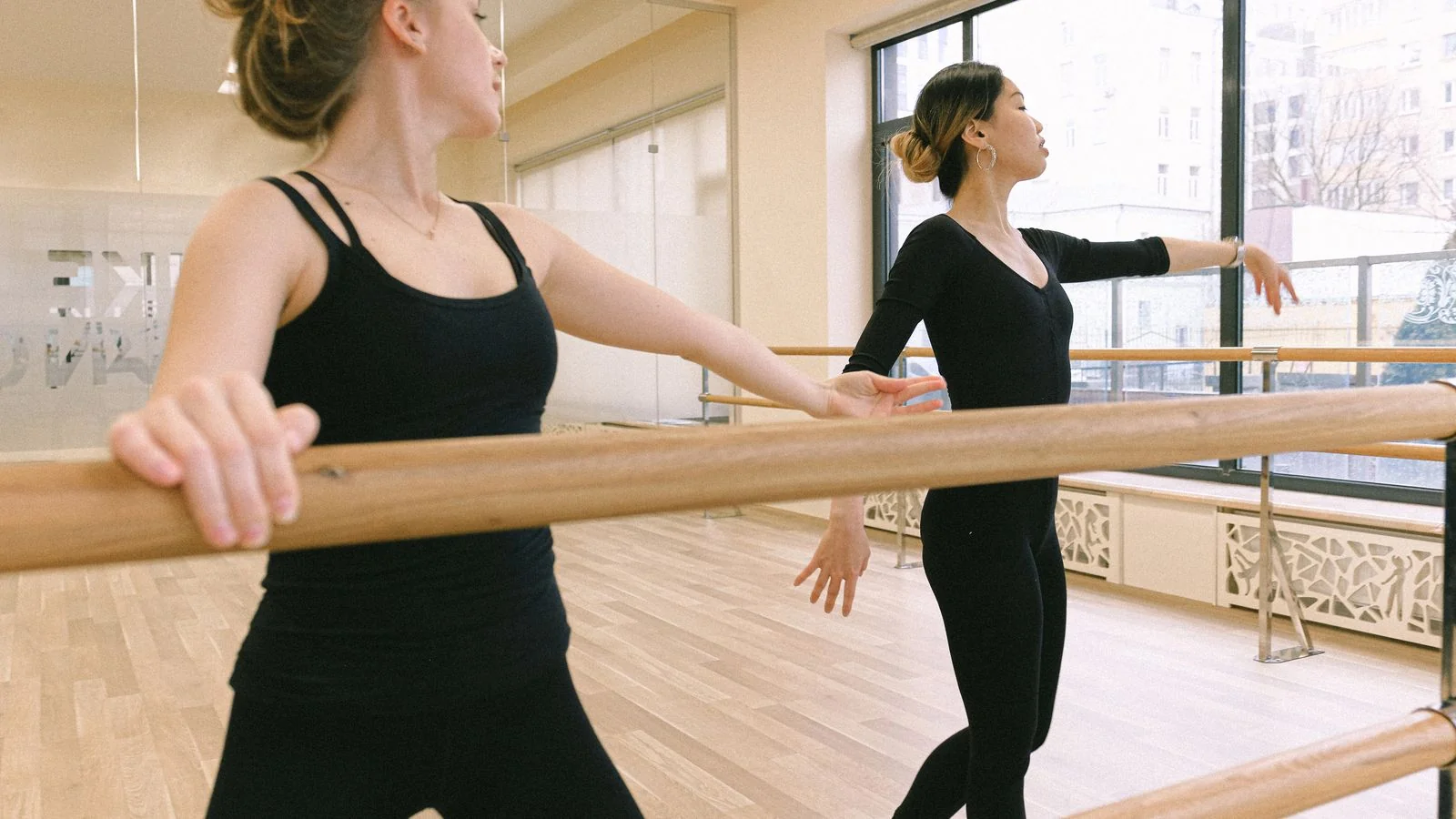
Write the page for the parent who has never done this
This is the highest value asset a dance studio can build and the one almost none of them have.
Call it something close to what a parent would say out loud. First dance class for a three year old. What to expect at your child’s first ballet class. Then answer, in plain sentences, every question a nervous first-time parent has and will not ask you on the phone.
What shoes she needs to buy, which specific kind, roughly what they cost and whether you sell them. What her daughter should wear if she does not own a leotard yet. Whether parents watch or wait outside, and if they wait outside, how she will know her child is fine. What happens in the first fifteen minutes. What happens if her child cries, freezes, or refuses to let go of her leg, which is the fear underneath all the others. Whether there is a trial class. What the recital costs, including costume, tickets and photos, because that number arriving as a surprise in March is the most common reason a family does not come back for a second year.
Write the cost paragraph honestly. Studios avoid it because they think transparency loses price-sensitive parents. It loses the parents who would have quit anyway and wins the ones who are comparing you against a studio that hid the number.
That page will get very little engagement. It will also be the page that shows up when a parent in your city types the question at nine at night, and it will still be doing that in three years.
Answer the age question with real specificity
Every studio says they offer classes for ages two and up. Almost none of them explain what a two year old actually does for forty five minutes, which is the thing a parent is trying to work out.
Write the developmental reality per age band. What a two or three year old class looks like, which is mostly imitation, circle games, animal walks and about four minutes of actual technique, and why that is correct rather than a watered down version of real ballet. What changes at five, when a child can hold a shape and follow a two-part instruction. What changes at seven, when technique can genuinely begin and when moving to a serious syllabus makes sense. What competition team involves in hours, cost and commitment, and who it is not for.
This content does something no testimonial can. It tells a parent you understand children, not just dance. Studios compete for enrollment largely on trust in the teacher, and trust in the teacher is demonstrated by explaining a four year old accurately to her own mother.

Publish against the enrollment calendar, not the studio calendar
Studios market when they are least busy, which is exactly backwards.
The searching happens earlier than the deciding. Parents begin looking for summer camps in April and May, and the studio a parent finds while casually looking for a two week camp in May is the studio she thinks of in August when the real decision arrives. Fall registration content that goes up in late July is arriving at a decision that is already two thirds made.
Work backwards from that. The stranger-facing pages go up in April. Camp and summer intensive content runs May and June, priced and described for a parent who has never enrolled anywhere. Fall registration pushes start in July with the already-warm audience your earlier pages built. January is the second real window, when new-year enrollment and mid-year transfers from studios that disappointed somebody are both live, and almost nobody markets into it.
The retention calendar sits on top of that, running its own rhythm through recital season and competition season, and it should not be allowed to displace the acquisition work simply because recital is emotionally louder.
There is a practical trap here worth naming. March and April are the busiest weeks of a studio year, which is exactly when the April acquisition work is supposed to happen. The only reliable solution is to write those pages in January and schedule them. A studio that plans to write stranger-facing content during recital preparation will not write it, this year or any year, and that single scheduling failure is why most studios have no acquisition content at all.
Budget one January afternoon per page. Six pages is a weekend. Those six pages will then work every April for the next several years with light annual editing, which is the closest thing to compounding a small business gets.
Turn parent questions into your content plan
You do not need keyword research to start. You need to write down what parents ask you.
Keep a running note at the front desk for a month. Every question a prospective parent asks on the phone, at a trial class, or in a direct message gets one line. At the end of the month you will have somewhere between twenty and forty questions, most of them repeating, and that list is your content plan for the next two years. Each question becomes a page. Each page is written in the words the parent used, not the words the industry uses.
This matters more now than it did five years ago, because parents increasingly ask the question of an assistant rather than a search box. When somebody asks ChatGPT or Google’s AI results where to put a shy four year old in dance classes near them, the answer is assembled from pages that plainly answer that exact question. A studio site made of three pages and a class timetable gives an assistant nothing to work with. A studio site with thirty plainly written answers gives it everything.
Order the list by anxiety rather than by search volume. The questions parents ask in a lowered voice are the ones that decide enrollment, and they are almost never the ones with impressive numbers attached. Whether her daughter is too big for ballet. Whether a boy will be the only boy. Whether autism or ADHD will be a problem in your classes, and what you actually do about it. Whether she can afford this. Whether her child is too old to start at nine, which feels absurd to you and is a genuine worry to her.
Each of those gets a page with a kind, direct answer. None of them will trend. All of them convert, because a parent who reads a straight answer to the question she was embarrassed to ask has already decided she trusts you.
One more mechanical point. Write the answer in the first two sentences of the page and then expand, rather than building to it. Parents skim and assistants extract from the top, so a page that opens with three paragraphs of context about your studio’s history buries the thing both of them came for.
Let current families do the acquisition you cannot do
The one place the two calendars legitimately meet is referral, and most studios leave it to chance.
Referral works best when you give a current parent something specific to hand over rather than a general good feeling. The page you wrote for first-time parents is that object. A mother whose friend mentions her daughter is shy does not want to give a sales pitch. She wants to send a link that does the explaining for her, and she will send it if it exists.
Ask for the introduction at the two moments when feeling runs highest, which are the week after recital and the week a child moves up a level. Make the ask small and concrete, naming the page rather than asking for a referral in the abstract.
What to stop doing
Three habits eat most of the available time in a studio’s content marketing for no return.
Reposting competition placements to a public feed. These matter enormously to the twelve families involved and read as an exclusive club to everyone else. Keep them, move them to a private parent group where they do retention work properly.
Chasing trends. A studio account doing a trending sound gets a spike of views from people in other states and no enrollment. Reach is not the constraint. Local relevance is.
Waiting for good footage. Studios delay publishing because the lighting is bad, the mirror is smudged, the class was messy. A phone clip of a real Tuesday class, posted weekly, outperforms a quarterly polished edit on every measure that touches revenue. Parents are not evaluating your cinematography. They are trying to work out whether their child would be alright in that room.
Done properly, content marketing for dance studios is less about production and more about honesty at the right moment. The studios that grow are rarely the ones with the best dancers. They are the ones that made it easy for a nervous parent to understand what would happen on a Tuesday afternoon, and then said so in writing where a stranger could find it.