What would your content strategy look like if it had to fit on one page taped above your monitor? Not the deck for the board, not the 40-page brand bible, the version a new writer could read in four minutes and then make the same calls you would make. Most teams cannot produce that page, which is the polite way of saying most teams do not have a strategy. They have a backlog.
The fix is a content strategy template with exactly five blocks. Audience, promise, pillars, cadence, measurement. Here is each block, a worked example, and the monthly ritual that keeps the page honest.
Why most content strategies never get used

The standard failure is over-specification. A strategy document grows until it answers every hypothetical, and in doing so stops answering the only question that matters on a Tuesday morning: should we write this piece or that one? When the document cannot settle a real prioritization argument in under a minute, people stop opening it, and the actual strategy becomes whatever the loudest stakeholder wanted that week.
The second failure is the missing no. A strategy that does not exclude anything is a wish list. The one-page format forces exclusion by starvation: five blocks, limited space, no room for “and also.” If a topic does not fit a pillar, the page says no on your behalf, which is most of what a strategy is for.
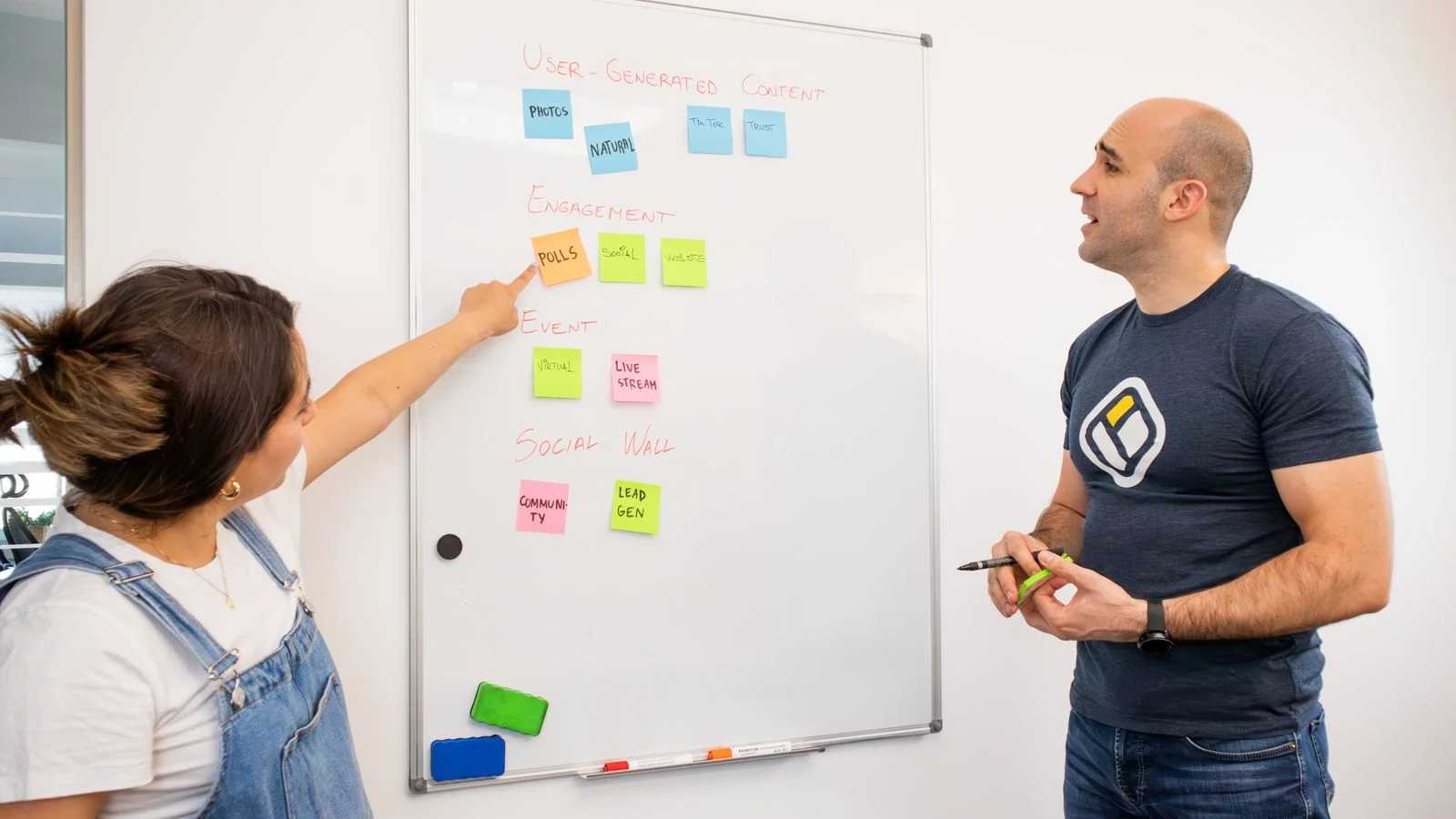
There is a third, quieter failure: strategies written by people who will not execute them. A consultant or a VP drafts the vision, hands it to a content team that was never in the room, and the document becomes a monument to a meeting. The one-page content strategy template fixes this by being cheap enough to draft together. Put the writers, the SEO lead, and the budget owner in one session, fill the five blocks live, and argue until the page survives everyone’s objections. A strategy the team fought over gets used. A strategy the team received gets filed.
The 5-block one-page template
Block one, audience, is a single sentence naming who the content serves, sharp enough to exclude people. “Operations leaders at 50-to-500-person logistics companies” works. “Businesses that want to grow” forbids nothing and therefore decides nothing.
A test for block one’s sharpness: could a writer use it to settle a vocabulary dispute? If the audience sentence tells you whether to say “doors” or “units,” whether to explain what an API is, whether a meme reference lands or embarrasses, it is doing its job. If two writers could read it and produce pieces for different humans, sharpen it before touching the other blocks, because every downstream choice inherits its fuzziness.
Block two, promise, states what that reader reliably gets from you that they cannot get elsewhere. One sentence again, and the test is the word reliably: a promise is a pattern, not a one-off. The promise also implies its own quality bar: if you promised the most specific answers in the category, a generic listicle is not a small miss, it is a broken promise, and readers track broken promises the way creditors do. Block three, pillars, lists the three to five topic territories you intend to own, each with a one-line reason tied to business value, what it sells, ranks for, or differentiates.
Block four, cadence, commits to a publishing rhythm you can hold on your worst week, stated as outputs per period per channel. Block five, measurement, names two to four numbers with current values and targets: organic sessions, qualified leads from content, share-of-answer in AI engines, whatever maps to why the budget exists. Numbers without current values are decoration. Write the baseline down even when it embarrasses you.
Two drafting rules keep the blocks honest. First, write block one before any other and revisit it last; every downstream argument about topics and channels is secretly an argument about audience, and a fuzzy block one guarantees fuzzy everything. Second, cap each block at 40 words. The cap sounds arbitrary until you watch it work: it forces the strategic choice out of hiding, because there is no room to hedge with “and various other segments” or “as resources allow.” If a block cannot be said in 40 words, the decision behind it has not been made yet, and the page is telling you so.
Fill in the blocks: a worked example

Take a fictional payroll software company selling to restaurant groups. Audience: “Owners and controllers of 3-to-30-location restaurant groups who run payroll in-house.” Promise: “The most specific answers anywhere to restaurant payroll compliance questions, written by people who have processed it.” Pillars: tip compliance (sells the core feature), multi-state payroll (differentiates against the big generic platforms), labor cost benchmarks (earns links and citations), onboarding and turnover workflows (matches the highest-volume search demand in the category).
Cadence: two long-form pieces per week, one benchmark report per quarter, one newsletter per week. Measurement: organic sessions (baseline 8,000 per month, target 20,000 in 12 months), demo requests attributing content as first touch (baseline 11 per month, target 30), brand mentions in AI answers for “restaurant payroll software” prompts (baseline: absent, target: cited in 2 of 4 major engines).
Notice what the page already settled. A trending-topic piece about AI in fine dining? No pillar, no slot. A request from sales for a generic “what is payroll” explainer? Fails the audience block; those readers run one location or none. The template is not paperwork. It is pre-made arguments.
The worked example also shows how the blocks discipline each other. The cadence block promised two long-form pieces a week, which the team of one writer and one editor can hold; the moment someone proposes adding a podcast, the cadence block demands to know what gets cut. The measurement block tied one number to AI answers, which forces the pillar content to be written in extractable, citation-friendly form rather than as wandering essays. A good content strategy template is a system of mutual constraints, and the constraints are where the strategy actually lives.
Turn the page into a calendar
The calendar translates pillars and cadence into named pieces. Work one quarter at a time: assign each pillar a share of the quarter’s slots proportional to its business weight, then fill slots two to four weeks ahead with specific headlines, owners, and due dates. Keep a parking lot for ideas that arrive mid-quarter so they stop hijacking the current week.
Two scheduling rules earn their keep. First, sequence clusters, not singles: three to five interlinked pieces on one pillar published across a month builds topical authority faster than the same five pieces scattered across the quarter. Second, protect a swing slot, one slot per week or two that can absorb a news peg or a sales request without displacing planned work. The swing slot is the pressure valve that keeps the rest of the calendar from becoming fiction.
Assign every calendar row four fields and refuse to schedule anything missing one: the pillar it serves, the primary question it answers, the owner, and the measurement it should eventually move. The second field does the most work. Forcing each piece to name the question it answers kills the vague topic entries (“something about compliance”) that rot calendars from the inside, and it doubles as AEO discipline, since answer engines retrieve content by the questions it resolves. A calendar of named questions is also self-deduplicating: you can see at a glance when two drafts are circling the same query and merge them before both ship weak.
Keep it alive: the monthly review
Once a month, put the one-pager next to the numbers and ask three questions. Which pillar earned its slots, by traffic, links, citations, or pipeline? Did we hold cadence, and if not, was the plan wrong or the execution? Did any measurement move enough to change next month’s allocation? The answers produce small edits, a pillar demoted, a cadence trimmed to something honest, a target revised. Small monthly edits are what prevent the big quarterly rewrite from being a funeral.
Keep a change log at the bottom of the page, one line per edit with the date and the reason. Six months in, the log becomes the most valuable artifact the team owns: a record of which bets paid, which pillars were hype, and how long each lesson took to learn. New hires read it and absorb a year of judgment in ten minutes. Executives read it and stop relitigating decisions the data already settled. The log also keeps the monthly review honest, because a team that must write down “we are demoting this pillar for the third time” starts asking better questions about why it keeps getting promoted.
The quarterly rewrite, when it comes, should feel like maintenance rather than revolution. Audience and promise survive most quarters untouched; pillars rotate one in or out; cadence adjusts to the team you have, not the team you planned to hire. If a quarterly review wants to change three or more blocks at once, something upstream shifted, the product, the market, the company strategy, and the right move is a working session with leadership, not a quiet edit to a marketing document.
A final word on tooling, because the question always comes up: the template needs nothing fancier than a document the whole team can open. Teams burn weeks evaluating strategy software when the binding constraint was never the container, it was the unmade decisions inside it. Pick the page, make the five calls, and spend the saved evaluation weeks publishing.
For proof that a tight plan beats an elaborate one, look at how we run the Instant Press blog itself. The entire operation reduces to one audience, one promise, eight pillar categories, and a fixed daily cadence driven from a single planning spreadsheet, ten posts a day, every day, with each post assigned a publish date weeks ahead. No 40-slide deck anywhere in the building. The one-pager and the spreadsheet are the strategy, which is exactly why they get used.